
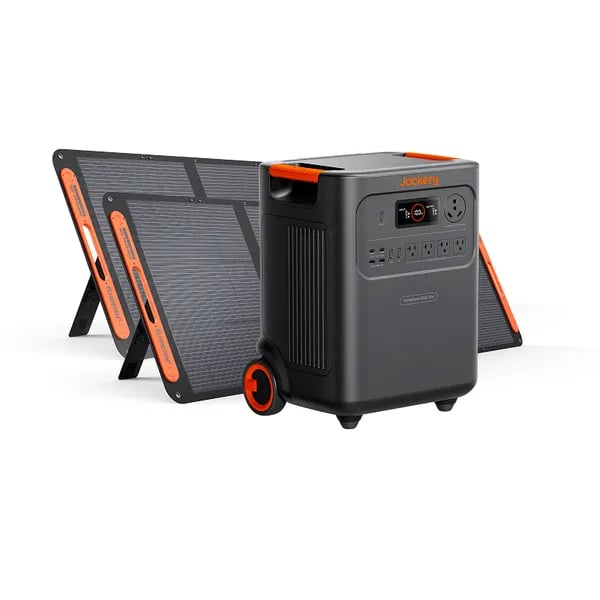
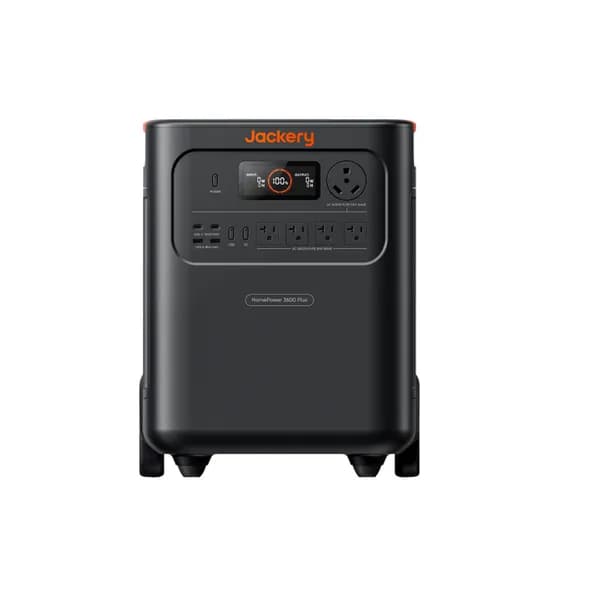
If you're like me, the grocery bag of frozen dinners in your fridge is a ticking reminder that power can vanish when you least expect it. I once hosted a backyard dinner that turned into a candlelit potluck after a storm took the grid down for a day — and that sparked my obsession with reliable backup power. You're reading this because you want to know whether the Jackery HomePower 3600 Plus can keep your lights, fridge, and perhaps even a sump pump humming when the grid doesn't. Spoiler: it's a serious contender.
Product Highlights — What Makes the HomePower 3600 Plus Tick
Big energy in a compact box: 3584Wh battery capacity + CTB build
The Jackery HomePower 3600 Plus is built for the moments you really need dependable backup—power outages, job sites, RV trips, or off-grid cabins. At the center is its 3584Wh battery capacity (that’s 3,584 watt-hours), using LiFePO4 (LFP) cells for long life and steady performance.
What helps it feel tougher (and smaller) than you’d expect is Jackery’s automotive-grade CTB (cell-to-body) design. Instead of treating the battery like a separate “brick” inside a case, CTB integrates the structure for better strength and space use. As Laura Stevens, Renewable Energy Consultant, puts it:
“Jackery's LFP approach with CTB makes the HomePower 3600 Plus both compact and robust—it's a smart step up for home backup.”
Serious output: 3,600W continuous with a 7,200W surge
Capacity is only half the story—output is what decides what you can actually run. The HomePower 3600 Plus delivers 3,600W continuous output and an impressive 7,200W surge, which is exactly what you want for appliances that spike at startup.
In real life, that means you can power essentials like:
- Refrigerators and freezers
- Water pumps
- Microwaves and kitchen circuits
- Some dryers and larger tools (depending on startup draw)
It also supports dual 120V/240V use, so you’re not boxed into “small device only” situations when you need bigger loads.
Portability that actually matters: world’s lightest smallest 3.6kWh LFP power
Jackery markets this unit as the world’s lightest smallest option in its class—a 3.6kWh LFP power station that’s still practical to move around. The wheeled design helps a lot when you’re rolling it from a garage to a patio, or positioning it near a transfer switch connection point.
And you’re not limited to one or two plugs. With multiple AC/DC/USB outputs, you can run up to nine devices at the same time, which is ideal when you’re juggling food storage, lighting, internet gear, and charging.
Safety and long-term value: ceramic membrane cells, 6,000 cycles, 5-year warranty
Backup power should feel safe inside your home. The HomePower 3600 Plus uses a high-temperature-resistant ceramic membrane in the battery cells, tested up to 302°F, designed to reduce thermal risk.
For longevity, it’s rated around 6,000 charge cycles (to 70%+ capacity), which Jackery frames as 10+ years of use for many owners. You also get a 5-year warranty, which adds peace of mind if you’re buying it as a serious home backup tool.
| Spec | Jackery HomePower 3600 Plus |
|---|---|
| Battery capacity | 3,584Wh |
| Continuous output | 3,600W |
| Surge output | 7,200W |
| Cycle life | ~6,000 cycles |
| Safety test temperature | 302°F |
| Warranty | 5 years |
Power Your Essentials — Real-world Performance (Chart)
When the grid drops, you don’t need “everything”—you need the basics. With 3,600W continuous output (and 7,200W surge) plus a 3,584Wh LiFePO4 battery, the Jackery HomePower 3600 Plus is built to Power Your Essentials like refrigeration, internet, lighting, and even medical devices. The big question is simple: can it keep your fridge running long enough to matter?
How long will it run your fridge, Wi‑Fi, and lights?
Jackery’s headline claim is “up to 14 days” for essentials in a family-of-three scenario—when you pair solar input with smart, efficient load management. In real life, your runtime depends on how often your fridge compressor cycles, how many lights you use, and whether you’re also powering things like a microwave or pump.
- Fridge + Wi‑Fi + LED lights are the sweet spot for multi-day outages.
- ChargeShield 2.0, smart temperature control, and quiet modes (≤30dB) help protect battery health while keeping noise low—especially helpful overnight.
- You can power up to nine devices at once, so you’re not constantly swapping plugs.
Dr. Mark Rivera, Energy Systems Engineer: "In tests, consistent 3,600W output plus reliable solar input makes the HomePower 3600 Plus a practical backbone for multi‑day emergency setups."
Real-world performance chart (key claims & specs)
| What you care about | What Jackery claims / provides | What it means for you |
|---|---|---|
| Fridge runtime claim | Up to 14 days (essentials scenario) | Best-case with efficient use + solar top-ups |
| Solar input example | 500W panel, ~4 hours to full charge (conditions dependent) | Supports fast four hour charging under ideal sun and setup |
| Solar panel option | SolarSaga 500X panels (500W TOPCon) | Higher output per panel; fewer panels to deploy |
| Solar efficiency | Up to 25% | More energy captured in limited space/time |
| Noise during charging | ≤30dB quiet mode | Low disturbance indoors or near sleeping areas |
| Solar options | SolarSaga 200W or 500X | Scale from “basic top-up” to “serious recharge” |
Scale up loads with dual voltage (120V/240V) + parallel operation
If your needs go beyond basics, the HomePower 3600 Plus supports dual 120V/240V operation and parallel setups. That means you can pair two units to handle 240V appliances (where supported), while still keeping your everyday 120V essentials covered.
Charging options: wall, solar, and expansion packs
You can recharge from an AC outlet, from solar (including SolarSaga 500X panels), or by expanding capacity with extra battery packs. For outages, solar plus efficient scheduling (run heavy loads in daylight, essentials at night) is what turns “hours” into multi-day coverage.
Installation, Safety & Everyday Use — Practical Notes
Manual transfer switch setup: choose what stays on
If you want a cleaner “home backup” experience (not just extension cords), pair the Jackery HomePower 3600 Plus with a manual transfer switch (MTS). This lets you back up specific circuits—like your fridge, lights, Wi‑Fi, or a sump pump—without feeding power back into the grid. That selective control is the big win: you decide which loads you keep running and avoid overloading the system.
Sofia Martinez, Home Energy Installer: "A manual transfer switch plus a system like the HomePower 3600 Plus gives homeowners predictable control during outages—it's a practical, serviceable solution."
Practical note: For any whole‑home or critical‑circuit wiring, hire a licensed electrician. An MTS is the safer way to integrate backup power because it isolates circuits properly and keeps line workers protected.
Supports 120V 240V dual: run small and large loads
The HomePower 3600 Plus Supports 120V 240V dual operation, which matters when you’re powering a mix of everyday devices and larger equipment. In real life, that can mean keeping kitchen basics going while also supporting higher-demand items (like certain pumps or tools) when needed. It also helps when you’re planning a more “panel-like” backup approach through an MTS.
Power Everyday Essentials (without juggling cords)
For daily outage prep, think in “must-have” groups. With up to 9 devices at once (AC, USB‑C, USB‑A), you can cover the basics without constantly swapping plugs.
- Kitchen + food: fridge/freezer, small microwave (short bursts), coffee maker
- Home basics: Wi‑Fi router, a few LED lights, fans
- Basement protection: sump pump (check starting surge needs)
- Personal devices: phones, laptops, power tool batteries via USB‑C/AC
Tip: start by plugging in only your essentials, then add comfort items after you confirm everything is stable.
Mobility: portable enough to actually use
A 3.6kWh unit sounds bulky, but Jackery’s CTB design plus a retractable handle and wheels makes it surprisingly manageable. That matters because you’ll move it: closer to the fridge during an outage, into the garage for charging, or near a window/porch when you’re using solar panels.
Safety first: ceramic cells + smart temperature control
Safety is built around LiFePO4 chemistry and high‑temp ceramic membrane cells tested up to 302°F to help prevent thermal runaway. You also get smart temperature control to reduce heat stress during heavy use. Still, keep it simple:
- Use it on a flat surface with airflow around vents.
- Keep it dry and away from direct heat sources.
- Don’t overload outlets—spread devices across ports.
Maintenance and scaling: expandable to 21kWh
LiFePO4 (LFP) batteries are known for long life (around 6,000 cycles), which can lower long-term replacement costs. If your needs grow, you can add Jackery Battery Pack 3600 units—currently $999.00 each—and go expandable to 21kWh for longer runtime or more “whole-home style” coverage.
| Use case | What to do |
|---|---|
| Short outages | Run fridge + Wi‑Fi + lights; charge phones via USB‑C |
| Multi-day outages | Add solar charging; prioritize essentials and rotate loads |
| Higher demand home backup | Use a manual transfer switch + add battery packs up to 21kWh |
Alternatives, Deals & Buying Guide (Comparison Table)
Best value right now: Save an extra 10 with bundles and battery discounts
If you want a serious home-ready unit that still feels portable, the HomePower 3600 Plus is hard to ignore. The standalone price is $1,599, but the real sweet spot is the bundle: HomePower 3600 Plus + SolarSaga 200W x2 for $2,099 (down from $3,699). And if you’re planning to scale, the discounted Jackery Battery Pack 3600 for $999 (was $2,099) is the kind of deal that can change your whole setup cost.
Ethan Cole, Consumer Tech Analyst: “Deals are where these systems get interesting—bundles with panels or discounted battery packs can change the total cost of ownership dramatically.”
Comparison table: Jackery vs Anker vs Nature’s Generator
| Model | Capacity | Output | Current price examples | Best for |
|---|---|---|---|---|
| Jackery HomePower 3600 Plus | portable power station 3584Wh | 3,600W (7,200W surge) | $1,599 standalone; $2,099 w/ SolarSaga 200W x2; expand setups up to $3,099; add Battery Pack 3600 at $999 | Balanced home backup + portability, easy expansion |
| Anker SOLIX F3800 Plus | 3,840Wh | 6,000W | $2,999 (was $4,799) | Higher output, higher price; bigger loads |
| Nature’s Generator Elite 3600W | Varies by bundle | 3,600W class | $669.99 to $994.99 (bundle-dependent) | Lowest upfront cost; watch what’s included |
How to choose (and when “We beat any price” matters)
Start with what you actually need to run. If you want a dependable, expandable system with strong support, Jackery is a safe bet—especially when you can stack promos like Save an extra 10 and lean on “We beat any price” style guarantees if your retailer offers it. If your goal is the most watts for the money and you don’t mind paying more, Anker’s higher output can be worth it. If you’re trying to spend the least upfront, Nature’s Generator can undercut everyone, but you’ll want to double-check bundle names (like Elite vs Gold System) so you’re comparing the same gear.
Deals, financing, shipping, and returns (your real-world buying checklist)
If the upfront cost is the only thing holding you back, financing can make this easy. Payment plans through Klarna, Affirm, or Shop Pay Installments can bring it down to around $189.45/month for 12 months at 15% APR (example). Also factor in the stuff you’ll feel later: Jackery offers same-day processing for orders before 2 PM PST, fast and free shipping, and free 30-day returns. If you’re a creator or recommend gear to friends, the 5% affiliate commission can be a nice bonus. In the end, the best pick is the one that fits your loads, your budget, and your timeline—then you lock it in when the bundle price drops.
